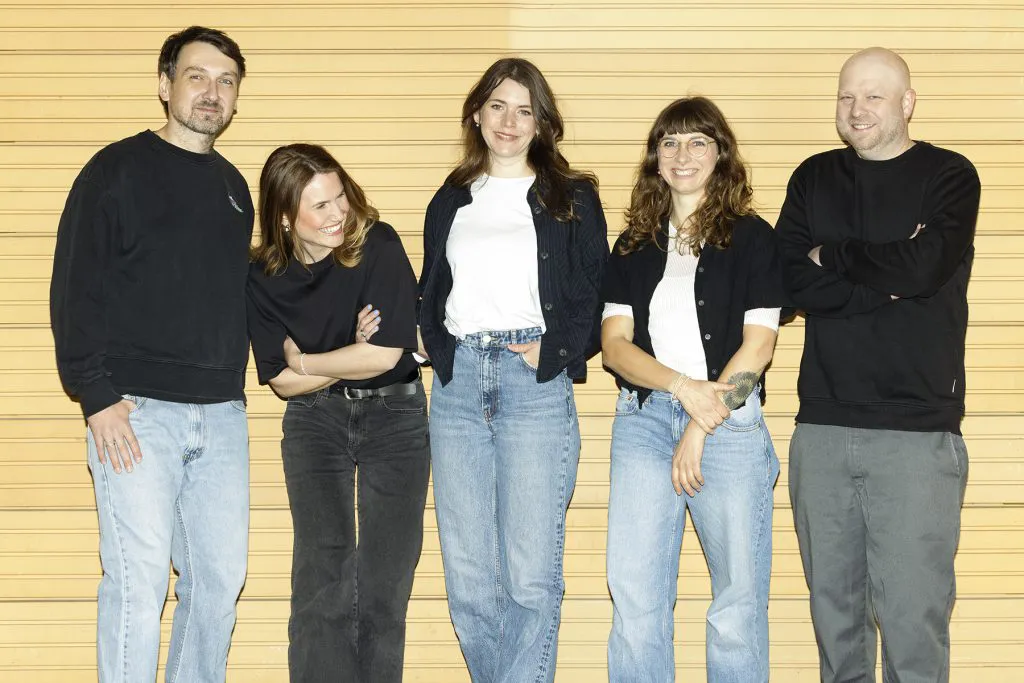
No script, no polish. Just raw answers about how we work, why we exist, and what we actually do. Here’s the conversation.
AI: Hi Ruben. I’m sitting down with you today to ask a few questions about how you work and how Ceeju operates. Thanks for making the time. Let’s start. People often ask what makes Ceeju different. Can you answer that?
Ruben: Honestly? I can’t. I’ve never worked at other agencies, only at university (TU Braunschweig), which isn’t comparable. What I can tell you is what we do: we try to do the right thing every day. We want things to run fairly, at eye level, with a good vibe. I have no interest in competition, pitches, or stress. With demographic change and all the other crises in the world, we’ve got enough to deal with – no need for capitalist growth structures or fighting each other. We just want to work calmly with good people on good projects. Sounds naive, but that’s what we do, and it works really well for us.
AI: So what is Ceeju, then?
Ruben: Ceeju is a digital and creative agency based in Berlin, with a network of 42+ freelancers across four business areas: Design & Branding, IT & Development, Architecture & Urban Development, and Art & Craft. We build small, agile teams for cost- and energy-efficient solutions. We’re a new kind of agency. We help people collaborate better. We give individuals more time, resources, knowledge, and opportunities by using digital tools and AI. We want communities where people support each other to grow beyond themselves. That’s the Bauhaus principle – bringing different disciplines together.
AI: Why a UG (limited liability company) and not a cooperative?
Ruben: We’re not a cooperative. We’re a UG, becoming a GmbH. It’s less bureaucratic in Germany. We can still behave like a non-profit GmbH or cooperative, but without the administrative overhead. Our role model is the Smart Germany cooperative – I was a member for three years. We take inspiration from their structure, but we need to stay flexible and keep things simple. We founded Ceeju on April 1st, 2025. Five partners. The idea had been brewing for 3-4 years. I was looking for a company structure without personal liability, where we could shape things ourselves and invent something new.
AI: Where are you based?
Ruben: We have our own coworking space in Berlin-Wedding, between Seestraße and Leopoldplatz. We renovated an empty building ourselves in 2020 – complete DIY job. That’s our physical home base. Beyond that, our network is everywhere. Five co-founders and one partner, 42+ people in the broader network. Some people call them “digital nomads,” but that’s not quite right – they have a home base with our office, they’re just often on the move.
AI: How big is the team?
Ruben: Five partners officially. One employee – me, the managing director. Everyone else is freelance. That gives everyone flexibility, but we still look out for each other and share knowledge. We have 42+ people in our network, depending on projects. It fluctuates.
AI: Who do you work with?
Ruben: Cross-industry. We work for construction companies, museums, event agencies, theaters, larger marketing agencies, film productions, non-profits, the food sector, AI firms, media, newspapers, city marketing, research institutions. We work with a wide range of topics and fields. We don’t really work for brands or companies – we work with the people trying to do their jobs. We support them as best we can with our skills and abilities.
AI: What’s your approach?
Ruben: No stress. We’re not saving the world. We only “just” do design, development, art, craft, and architecture. We’re not doctors. That said, we take our work very seriously and work as professionally as possible. But most of the time, we’re helping reach target groups, improve marketing, sell products, services, or ideas. We do that calmly, with the utmost seriousness. But we’re open, honest, and we know what we’re doing here. We’re up for it, but we don’t need to overdo it with buzzwords, stress, overtime, or weekend shifts. We’re all human, and we take things step by step, ideally in long-term partnerships, through whatever challenges come our way.
AI: What’s your vision?
Ruben: Everyone gets paid fairly. You don’t have to work full-time to live well. We move away from focusing purely on economic growth. We distribute wealth and assets fairly. If the individual is doing well, society is doing well. We try to live this in our small way and hope to inspire others to think that things can be done differently.
AI: What are your values?
Ruben: Transparency, honesty, fairness, calm, professionalism, clear structures, clear responsibilities, treating each other fairly. How do we live them? We try every day. It’s hard work, but we do it.
AI: What services do you offer?
Ruben: Four business areas, following the Bauhaus principle – bringing crafts together. Design & Branding: Visual identities, design systems, UX/interface design, editorial & campaign design, art direction, color concepts, logo development, dynamic branding, typography, illustrations, infographics, redesigns, brand guidelines, employer branding, brand experience, presentations, animation, posters, book & editorial design. IT & Development: Websites & platforms, accessibility & performance, content structure & SEO, data management & interfaces, web design, SEO & digital visibility, UX/UI design, storytelling & scrollytelling, testing & QA, style guides, CMS setups (WordPress, Webflow, Typo3), custom code, e-commerce, hosting & maintenance, micro interactions, technical support. Architecture & Urban Development: Participatory neighborhood development, interim use & pop-up formats, coworking & community concepts, space concepts for participation & education, workshops & moderation, visual participation tools, exhibition design, project communication & public relations, architectural drawings & planning, mapping & urban analysis. Art & Craft: Figure construction & makeup, scenography & spatial design, illustration & object design, model building & prototyping, prop construction & material experiments, costume design, spatial installations, stage & exhibition design.
AI: How does a typical project run?
Ruben: For a web project: Request → briefing → define team (skills, 2-5 people) → concept → design → prototyping/wireframes → content → development → testing → go-live. What’s important: Clear responsibilities. What’s on us, what’s on the client, what’s on third parties. Then we build a project plan and get started.
AI: What’s your quality standard?
Ruben: High, whether it’s a small or large budget. Budget equals time. More budget means more time for preparation and prototyping. But you can do a lot with less budget too. You just have to be aware that time is bought with money – we all have rent and living costs. But the standard is high either way. You just have to clearly define what the goals are and what the results should deliver. Ideally, define measurable goals so you can analyze whether you achieved them afterward.
AI: How do you choose projects?
Ruben: We’ve only turned down a project twice – when it was too close to factory farming or the meat industry. Basically, industries I personally wouldn’t support and don’t want our tax money flowing to. Otherwise, we’re pretty open. We don’t have strict criteria. That happens case by case. And if during the project process you realize you’re not on the same wavelength, we’re fine ending the project. We’re not upset. You have to get to know each other during a project, and if it doesn’t work, you don’t have to force it to the end. We’ll hand over all our results so far and wish everyone good luck.
AI: Can you name 2-3 example projects?
Ruben: Score Media Group: We’ve been with them since they entered the market. We do basically everything related to the internet and provide advisory support for development, design, and support. It’s a perfect example project. I personally just hit my 10th anniversary with them this year (2026). I’ve been there longer than some of the employees. Gut und Bösel: Brand relaunch, new brand development, then a website including shop system. Max Siedentopf / Berlin Art Week: Hyperrealistic hands for the artist. We discussed the concept, then built the figures in our workshop and installed them at Soho House. The process is similar whether it’s a physical object or a website. Request, discuss, refine or receive briefing, create concept, project flow.
AI: How do you work with clients?
Ruben: Very well, probably. Seriously – we have many long-term clients. We might do a website for a new client, it goes live, then we continue supporting them with maintenance and support. We transition into retainer contracts – framework agreements that run yearly. We have a dozen, maybe a dozen and a half (12-16?) framework contracts with companies we’ve been supporting since 2014, 2016. We’re the constant. Sometimes contact persons change, employees change, but we’re there. We know the structures, the people responsible, the other IT or server providers. We’re really embedded within companies. That’s our approach – to be seen as part of a company, even if we’re not employed there. At some point, we become harder to replace. On the other hand, we’re also cheaper than a full-time employee because we bring way more skills. With one or two employer gross salaries per month, you theoretically get the know-how of 40 people, depending on the specific case or problem. That’s what I understand as the future of work – not “new work,” but how can we collaborate, share knowledge, work well together, save costs in the sense that we don’t need as much staff, and just approach things efficiently. Because we’re going to lack people in the future. AI will support us well, but it won’t take over everything. That’ll take another 10 years, maybe.
AI: What’s your approach to design and development?
Ruben: I’m completely self-taught, so I never attended those Scrum Master workshops from the employment office. I was never unemployed, so I never had the opportunity. Tools? Currently we use Notion because it can do pretty much everything we need. Project management, sales pipeline, tickets, support tickets, meeting documentation, etc. And it costs a fraction of everything else combined – Asana, Hubspot, you name it. That’s our only tool. Of course we use Slack, and we have our own social network, the CU.App. Development is currently changing abruptly 180, 360 degrees because of AI stuff. Design – my personal approach is as simple as possible, but I’m not a designer here. Julie Finkel, our Head of Design & Branding, would have to answer that.
AI: What technologies/tools do you use?
Ruben: Notion, Things 3, Codex, Visual Studio Code, Adobe Creative Cloud, Slack. For code: WordPress/PHP, HTML, CSS, vanilla JavaScript, Flickity, and MySQL (plus WP-CLI and Git).
AI: What makes your project work different from competitors?
Ruben: I can’t say. I don’t know how others work. A client once said that I don’t constantly freak out, don’t throw around buzzwords, and don’t artificially overcomplicate things in IT and programming. That happens a lot in the IT field – people seem to be very show-y and use buzzwords for everything, making things unnecessarily complicated. I find that wrong. But I can’t say what others do because I don’t know.
AI: What does “Community” mean at Ceeju?
Ruben: In 2020 we renovated an empty space in Berlin-Wedding by chance – completely DIY. That’s now our coworking space. Around 42+ people come and go irregularly. We’ve all been self-employed since around 2011, some longer. We’ve always worked in loose networks. Ceeju is the umbrella brand, if you want to call it that. Community means exchange is important to us. Supporting others is important. Supporting freelancers during parental leave or maternity protection, stepping in for vacation coverage. That’s what community means to us. Not throwing great parties – we do that anyway, or go for a beer or dinner. But it means standing up for each other when you don’t feel like covering someone’s vacation. Supporting each other when things aren’t going great, or when someone’s in parental leave. Helping each other with tax questions, all the stuff where German bureaucracy makes life hard for freelancers. We try to provide community.
AI: What’s the Network?
Ruben: The CU.App is a startup from Hanover. All our people are in it (coworking users and partners). Anyone can become a member. Models: Friend tariff (5 EUR/month for the digital platform, meeting room bookable for 15 EUR/hour), Coworking membership (60 EUR/month for 40 hours in our Berlin office).
AI: What’s the Social Platform?
Ruben: ceeju.io/app. There are various functions. There’s a social market where you can offer services to other members at a discount – portrait photos, for example. We have different groups where you can exchange on specific topics. We have events in there, and you can book resources like the coworking space or cargo bike, and hopefully soon a car-sharing car. It’s basically like Facebook used to be, but with people you know and without ads. Only our own mutual advertising.
AI: What does Engagement mean?
Ruben: I personally researched and worked at TU Braunschweig from 2018-2020 on participation and neighborhood development. We developed a participation platform, and various projects emerged from that – for example, a food-sharing pop-up concept. In 2020 we founded an association oriented around the 17 UN Sustainability Goals. We’re closely intertwined with it. We’re the digital partner of the Get Change Done e.V. association. We do too little as I’d like, but that was largely due to the pandemic. But we do a few small projects like the parklet – a wooden structure for a parking space in front of the office with a raised bed. That’s what engagement means. We’re planning to revive it from 2026 onwards. We have the ability to support anyone who wants to start community-oriented projects. We also offer our space for free or very cheap to neighborhood initiatives, student projects, or other non-profit organizations.
AI: Why do you do research, and what’s your focus?
Ruben: The research focus is digitalization and urban/neighborhood development. I studied City and Regional Management but work as a programmer. The research is about figuring out how we can offer spaces in urban areas as cost-efficiently as possible. We try to provide our 100 square meters to as many people as possible for as little money as necessary. We don’t want to deal with space in a profit-oriented way. That’s very interesting – it’s kind of a case study we’re doing. We have 30 people on 5 bookable flex desks, and we have 15% utilization. That’s very, very interesting. The research is more about how we can use empty spaces differently than urban development has planned in recent years. Because since Corona, classic urban development doesn’t work anymore, and with online retail, cities no longer function as pure consumer spaces. We need to rethink that. That’s where the research is currently going. We also want to spin out the TU Braunschweig participation platform concept and see how we can apply it in other contexts – a daycare center or a new housing development, for example. How can we design neighborhood development participatively so everyone can participate? It’s a mix of research, prototyping, and bringing our skills together. Currently the focus is on neighborhood development, share economy concepts, coworking. It doesn’t have to be coworking – it can be another type of space. Our office has become more than just an office. It’s a social place, a third place. For little money – that’s always the focus. That’s why people can afford it. That’s why they come. Not often, but they come. They come more often to social events than to work, but the space works.
AI: What’s CU.Office Berlin?
Ruben: Founded in 2020. We had two questions: (1) How can we make everyday work as resource-friendly as possible? We focused on second-hand furniture, did everything ourselves in DIY, and work with green and sustainable contracts (for example, electricity). (2) How can we provide spaces to as many people as possible for as little money as necessary? That’s basically our office: founded spontaneously and grown organically since 2020. Simply put, it’s a coworking space — but also a bit more than that. Not an artificial coworking space founded by some company, but an organically grown construct. Like WeWork, just really small and without a profit motive.
AI: What’s CU.Box?
Ruben: CU.Box is the working title for the spin-off of the participation platform “Sandkasten Selfmade Campus” from TU Braunschweig. We’re currently testing the construct minimally at a daycare center.
AI: What kind of prototypes do you develop?
Ruben: We’re doing a lot with time tracking calculators right now – to see how much you actually work per week, how much of that you’re focused. In 2025 I built a prototype in Dessau for an urban development project by Neulandia, the Summer of Pioneers. There was no event calendar, so we built a participatory, low-threshold event calendar relatively quickly – the Dessau Magazine. That was very interesting. With all the AI stuff in 2026, it would work completely differently now, but back then it worked very well too. Unfortunately the project wasn’t extended, so the prototype was discontinued.
AI: How is the team structured?
Ruben: Five partners, four business areas. Ruben (me): Managing director + urban development. Julie Finkel: Design & Branding. Nils Uliczka: IT & Development. Jan Augsburg: Architecture (partner, works for the Foreign Office, wasn’t in Germany during the founding). Sophie Ilg & Julia Heppner: Art & Craft (they have a studio in Friedrichshain and build hyperrealistic figures for film productions, theaters, and museums).
AI: Who can become a member?
Ruben: There’s no initiation ritual. You work together, you get along, you like each other, and then you start working together. That doesn’t happen with an application form. It happens when it happens. Except if you just want to do coworking. Then you just become a member after a trial day, introduce yourself, and it usually works out. But we’re not an elite club with weird selection criteria. Everyone is welcome.
AI: How do you work together internally?
Ruben: Regular partner meetings, regular office meetings. We work according to the principle of Eva Stützel from 2026 onwards – we’re testing that out. We have our CU.App for communication. It’s a mix of real meetings and digital documentation and communication.
AI: Remote, office, or hybrid?
Ruben: Hybrid. Some in the office, some at home, craft people in the workshop or on film productions or on tour. We work everywhere. Sometimes we meet up, and that’s important. Regular meetings are important. Regular online meetings are good too, but regular real meetings are even better.
AI: How do you make decisions?
Ruben: We’re not a cooperative. Each partner has voting rights according to their shares. The plan is to add Get Change Done e.V. as another partner with voting rights. We have a plenum in the office. From 2026 we’re working in circles according to Eva Stützel – that’s new, I’ve only had it on my desk for two weeks, implementing that in organizational management.
AI: What makes your work culture special?
Ruben: That’s a stupid question. There’s nothing special. We work together, earn money together, and sometimes drink a beer together or wine or go out to eat. Or go to the playground with the kids and enjoy ourselves. There’s nothing special. Maybe that’s what’s special.
AI: What benefits do members have?
Ruben: The support of the group when things go badly – vacation coverage, as mentioned, maternity/parental leave coverage. We’re also working toward having enough capital reserves so we can pay bills or even hire people if problems arise. Those are things. We’re still young, but that’s the direction we want to go – similar to the Smart Germany cooperative. We just want to support each other. As Gerald Hüther says, we want societies where people encourage each other to grow beyond themselves. That’s a benefit, but everyone has to actively do that and contribute. Otherwise there are no benefits, except cheap office space, maybe a cargo bike, maybe a car-sharing car, maybe a location somewhere by the sea. But that’s future music.
AI: How can someone become part of Ceeju?
Ruben: In the process – you work together and then become a partner. But that’s a long-term process. Then we have our coworking members. You can just become a member, or you can become a Friend and be part of the digital network. And you can do an internship. We’re happy to offer that and give our best to provide a good internship. My own internship was so shit and I learned nothing, so anything is better than mine back then during my practical semester. We rely on personal initiative and want to support people in what their personal goal is and then support their personal project. That’s Ceeju. No elevator pitch. Just how I work. If you want to work with us, get in touch. If you want to join the community, come by. If you just want to talk – let’s grab a coffee.
AI: Thanks for your time, Ruben.